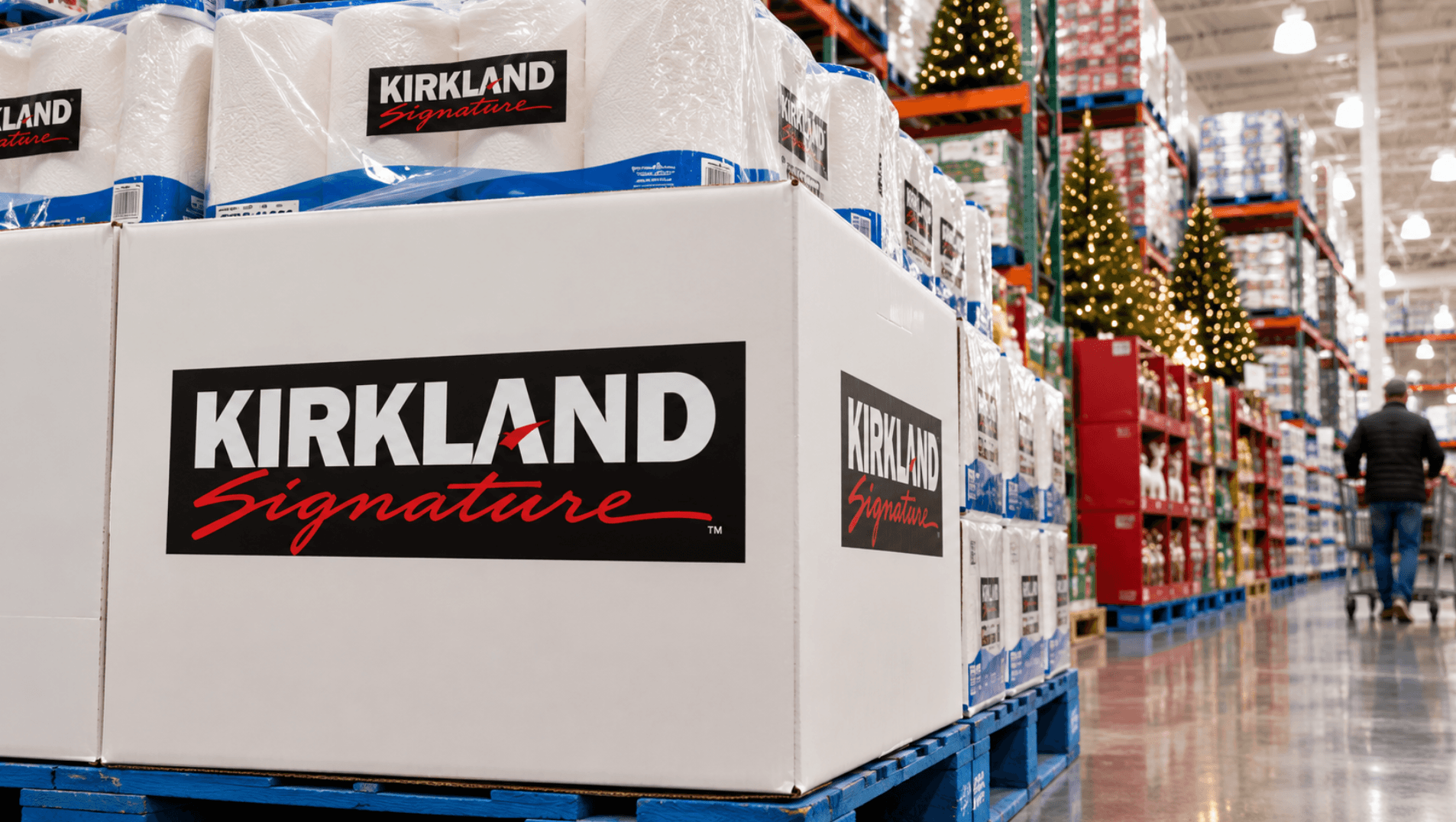
Kirkland Signature: The Operation Behind $90bn

Kirkland Signature generated around $90bn of sales in 2025. That is more than Nike and Adidas combined.
It has no stores of its own. No flagship. No advertising to speak of. It is sold in exactly one place, and the company that owns it makes an 11% gross margin on the merchandise it sells.
The reason this is worth a proper look is that Kirkland is not really a brand story. It is an operating story. The label sits on top of one of the most disciplined buying, stocking and distribution systems in retail, and the label only works because the system underneath it does. This is a breakdown of that system, from the filings.
Where the $90bn comes from, and what it is not
Two things need saying about the headline number before anything else, because most coverage gets them wrong.
First, Costco does not report Kirkland Signature as a line in its accounts. The $90bn is a figure the company has cited, most recently at its 2026 annual meeting of shareholders, and it follows the roughly $86bn that the Wall Street Journal reported for the prior year (Grocery Dive, September 2025; Costco 2026 annual meeting, as reported). It is management's number, not an audited segment. It is also entirely consistent with the accounts: Costco's fiscal 2025 net sales were $269.9bn, and Kirkland at about a third of sales lands at $90bn (Costco FY2025 10-K).
Second, the comparison holds. Nike reported $46.3bn of revenue for its fiscal 2025 (Nike FY2025 10-K). Adidas reported a record €24.81bn for calendar 2025, roughly $29.5bn (Adidas preliminary results, 29 January 2026). Together, about $76bn. A private label sold through one retailer outsells the two largest sportswear companies on earth, combined, by around $14bn.
The business it sits inside
Kirkland does not exist on its own. It exists inside Costco, and Costco's fiscal 2025 numbers are the context for everything that follows.
Costco, fiscal 2025 | |
|---|---|
Net sales | $269.9bn (up 8%) |
Merchandise costs | $239.9bn |
Gross margin | $30.0bn, or 11.12% |
Membership fees | $5.32bn (up 10%) |
Net income | $8.10bn (up 10%) |
Operating cash flow | $13.34bn |
Warehouses at year end | 914 |
Total cardholders | 145.2 million |
Renewal rate, US and Canada | 92.3% |
Source: Costco Wholesale Corporation Form 10-K for fiscal 2025.
Since then Costco has reported fiscal 2026, the year to 30 August 2026: net sales rose another 10.1% to $297.2bn (Costco Q4 and fiscal 2026 results, 24 September 2026). The system keeps compounding.
Hold onto three numbers from that table. An 11.12% gross margin, which is roughly half of what a conventional grocer runs. $5.32bn of membership fees against $8.10bn of net income. And 92.3% of members renewing every year. Those three numbers explain each other, and Kirkland is what connects them.
The assortment: roughly 4,000 things, not 40,000
Costco's own description of its model, in the first pages of its 10-K, is that "offering low prices on a limited selection of nationally-branded and private-label products in a wide range of categories will produce high sales volumes and rapid inventory turnover" (Costco FY2025 10-K). "Limited selection" is doing a lot of work in that sentence.
A typical Costco warehouse carries approximately 4,000 stock-keeping units (Costco annual letter, as cited). A conventional supermarket carries somewhere between 30,000 and 60,000. A large supercentre can carry well over 100,000. Costco chooses not to offer thirty versions of the same product. It offers one or two, in a large pack, on a pallet.
The consequences run through the whole operation. Fewer items means more volume per item, which means more purchasing power per item. It means less complexity in replenishment: 4,000 things to forecast, order and count, not 40,000. It means product can be displayed on the pallet it arrived on, with no shelf-stocking labour. And it means every item on the floor has to justify its place, because the space it occupies could go to something that sells faster.
That last point is how Costco's buyers are actually managed. CEO Ron Vachris has described it plainly: buyers "are really rewarded based on volume of items, not how much we can make off every item," and a buyer who finds an item doing $4,000 per warehouse per week is the one who gets excited, "as opposed to making a higher margin percentage on the item" (Vachris, as reported). The incentive is velocity, not markup. That is the opposite of how most retail buying is run, and it is the reason the range stays tight.
Kirkland itself is held to the same discipline. It spans several hundred products globally, across categories from batteries to wine to bath tissue, and every addition to the line requires the CEO's personal sign-off (Grocery Dive, September 2025). A private label that a CEO personally gatekeeps is not a private label that sprawls.
The buying: a markup cap, and manufacturers you have heard of
Costco's price advantage is not a marketing position. It is a rule.
The company is widely reported to cap its markup at around 14% on national brands and 15% on Kirkland Signature, against typical supermarket margins in the mid-twenties and above (Vachris and Costco, as widely reported). The 10-K states the outcome without the mechanism: Kirkland products are "generally priced below national brands" and "generally earn higher margins" than the national brands they sit next to (Costco FY2025 10-K). Kirkland is commonly reported to sell at around 15% to 20% below the comparable national brand.
Read those two facts together, because they seem to contradict each other and do not. Kirkland is cheaper for the member and more profitable for Costco. That is only possible if the product costs Costco materially less to buy, which is the whole point of the model: a manufacturer producing to Costco's specification, at Costco's volume, with no marketing, no brand overhead and no slotting fees, can sell it to Costco for far less than the branded equivalent costs. Costco keeps some of the gap as margin and passes the rest to the member as price.
And the manufacturers are not obscure. Many Kirkland products are widely reported to be made by the national brands they compete with: coffee by Starbucks, tuna by Bumble Bee, nappies by Kimberly-Clark, wine by E&J Gallo (as reported). The same factory, a different label, a lower price, and a specification Costco controls. Where a category justified it, Costco has gone further and built its own production, with poultry the best-known example.
The specification is the part founders should note. Costco's stated standard for Kirkland is that the product must match or exceed the quality of the national brand at a lower price. That is a supplier brief, not a slogan, and it is enforced by a buying team that is measured on how fast the product sells, not on how cheap it was to make.
The distribution: buy direct, touch it once
The supply chain is described in one sentence in the 10-K, and the sentence is worth quoting in full: "We buy most of our merchandise directly from suppliers and route it to cross-docking consolidation points (depots) or directly to our warehouses" (Costco FY2025 10-K).
No distributors. No wholesalers in the middle. Product comes from the manufacturer either straight to the warehouse or through a depot, where large inbound shipments are broken down and moved out to warehouses quickly rather than stored. The company's own language for what this achieves is "reduced handling of merchandise in no-frills, self-service warehouse facilities."
Fewer handling stages. Larger shipments. Lower distribution cost per unit. And a product that arrives on a pallet, is sold from the pallet, and never sits on a shelf being restocked by hand.
The measure of how well this works is inventory turnover, and Costco's is best-in-class among US mass retailers. Fiscal 2025 merchandise costs of $239.9bn against average inventory of roughly $18.4bn gives about 13 turns a year (calculated from Costco FY2025 10-K balance sheet and income statement). That is roughly 28 days of stock. A typical general merchandise retailer turns five to seven times.
Then comes the line in the 10-K that explains the cash engine: "We often sell inventory before we are required to pay for it, even while taking advantage of early payment discounts" (Costco FY2025 10-K). At 28 days of stock and supplier terms longer than that, the member has paid Costco for the product before Costco has paid the manufacturer. The inventory is, in effect, financed by the supplier and paid for by the customer. That is how a business with an 11% gross margin generates $13.3bn of operating cash flow.
The membership: where the profit actually lives
This is the part of the model most people know and fewest people run the numbers on.
Membership fees were $5.32bn in fiscal 2025, up 10%, driven by new sign-ups and a fee increase in the US and Canada that took effect in September 2024 and accounted for around 40% of the growth (Costco FY2025 10-K). Net income was $8.10bn. Membership fees are therefore equivalent to around two-thirds of Costco's entire profit, from a revenue line that is less than 2% of sales and costs almost nothing to service once the card is issued.
The fees are collected up front and recognised over the year, which means Costco is holding a year of member cash before it has delivered the year of savings. There were 145.2 million cardholders at year end. Executive members, who pay the higher fee, numbered 38.7 million and accounted for 73.6% of worldwide net sales despite being well under half of the paid base (Costco FY2025 10-K). And 92.3% of US and Canadian members renewed.
Now put the pieces together, because they are one machine, not three.
The membership fee is only worth paying if the member saves more than the fee. The savings come from prices set at a capped markup on a narrow range bought at enormous volume. The volume comes from the narrow range and the member's frequency of visit. And the product that most reliably delivers the saving, at the best margin for Costco, is Kirkland, because Costco controls its cost and its specification.
So the member pays for the right to buy Kirkland cheaply. Kirkland's margin, thin as it is, covers the cost of running the warehouses. The fee is the profit. And the 92% renewal rate is the evidence that the saving is real. Take any one of those out and the others stop working.
What does not transfer
An honest read of Costco includes the parts you cannot copy.
Almost everything above is a function of scale. The purchasing power comes from $270bn of sales. The supplier terms that let Costco sell before it pays come from being a manufacturer's largest customer. The depot network exists because there are 914 warehouses to feed. A brand doing $10m cannot cap its markup at 15% and survive, because it does not have Costco's volume to make 15% pay.
The membership model is not a trick that works anywhere. It works because Costco members visit roughly weekly, spend heavily, and can see the saving in their basket. A DTC brand that sells a customer twice a year cannot charge a fee for the privilege.
The thin margin cuts both ways. An 11% gross margin leaves no room for a bad buy, a slow line or a distribution mistake. Costco's model is unforgiving of error, which is precisely why the operation is so disciplined. Most brands could not run at that margin for a quarter.
And Costco has its own exposures. It was slow to e-commerce relative to its scale. Roughly 10% of its sales are petrol, a low-margin, volatile line. It imports heavily and is exposed to tariffs. Its gross margin gain in 2025 was 20 basis points, partly gasoline deflation, partly credit card income (Costco FY2025 10-K), not a structural leap. It is a very good operation, not a magic one.
What this means if you run a scaling brand
You will never have Costco's scale. But the decisions that built Kirkland are decisions, not accidents of size, and scaled-down versions of every one of them are available to a $5m to $100m brand.
Fewer things, bought deeper. Costco's whole model rests on saying no to most of the assortment it could carry. Most scaling brands do the opposite: every new SKU, colour and size feels like growth, and the range sprawls until the winners are starved of stock and the tail is full of cash. The Costco question for your range is the one its buyers are measured on: what does each item sell per week, and would that shelf space and that cash do more elsewhere? ASOS and Burberry both cut their ranges to recover margin. We broke down how, and weeks of cover by SKU is where the analysis starts.
Buy direct and touch it once. Costco removes every intermediary it can and moves product through the fewest hands possible. For a scaling brand the equivalent is a hard look at how many parties sit between your factory and your customer, and what each one costs per unit. Every extra handling stage is margin. If your product is moving through a forwarder, a consolidator, a 3PL and a fulfilment partner before it reaches anyone, ask which of those you actually need. Our guide on how to choose a 3PL covers the trade-offs.
Turn stock, do not store it. Thirteen turns a year and product sold before it is paid for is the Costco cash engine, and it is the single biggest lever most consumer brands leave unpulled. Slow-turning stock is not an asset. It is cash you have converted into something that cannot pay a supplier. The two disciplines that move this number are buying to real demand rather than to hope, and negotiating supplier terms that stretch past your sell-through, so the customer pays you before you pay the factory. Our note on inventory forecasting methods covers the first; the second is a negotiation most brands never have.
Price for volume, not for markup. Costco's buyers are rewarded on velocity. Most brands price each product to maximise its margin and then wonder why the range moves slowly. The Kirkland logic is that a lower margin on a product that sells five times as fast is worth far more than a fat margin on one that sits. That is a pricing decision and an inventory decision at the same time, and it is worth testing on your slowest, highest-margin lines.
Let the product be the marketing. Kirkland spends almost nothing on advertising because the saving is the message and the member sees it every visit. A brand that has to pay to acquire every sale is a brand whose product is not doing enough of the selling. The operational version of this is fulfilment, returns and reliability: the parts of the experience that make a customer come back without being paid to.
Decide what your membership is. You cannot charge a fee, but the underlying idea, that the relationship is the asset and the product is how you keep it, is exactly what subscription and replenishment brands are built on. Costco's 92.3% renewal rate is a retention metric. If you do not know yours, and what it costs you when it drops, that is the first number to build.
Kirkland did not become a $90bn brand by putting a cheaper label on existing products. It grew inside an operation designed, from the buying incentive to the pallet on the floor, to sell the right products in enormous volumes at the lowest cost of getting them there. Most brands think about how to sell more. Costco built a machine for selling less, better, to people who keep coming back.
If you want a second pair of eyes on your range, your supply base and how fast your stock actually turns, see how we work.