Burberry: The Operations Behind the Turnaround

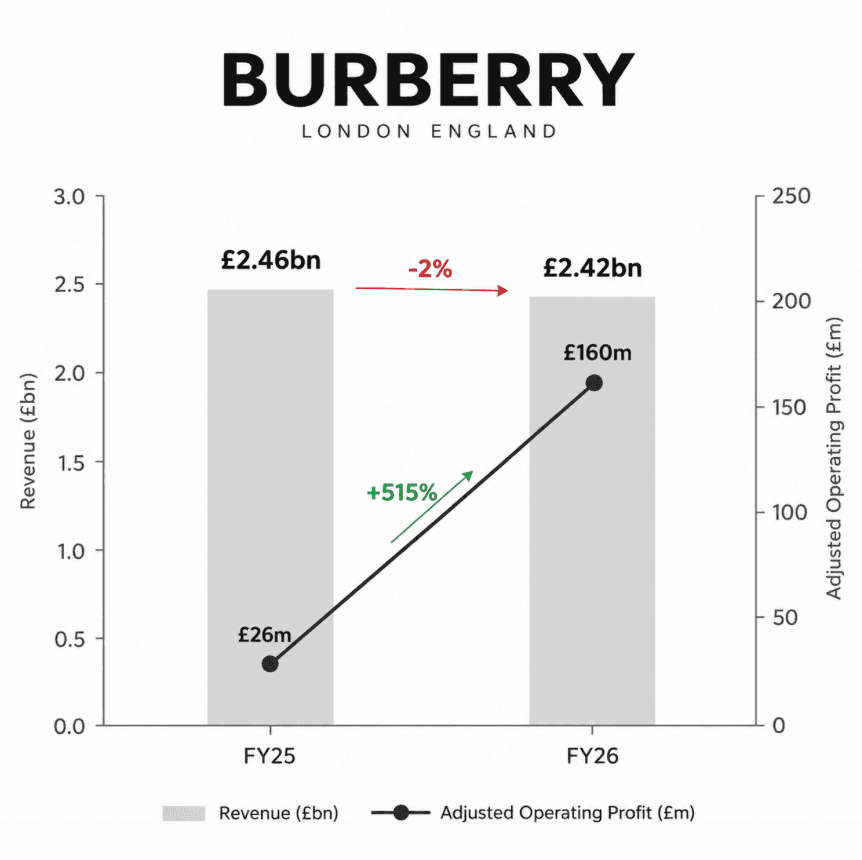
Burberry lost £41m of revenue in its last financial year. Operating profit went up £134m.
Revenue slipped from £2,461m in FY25 to £2,420m in FY26, down 2% at reported rates and flat in constant currency (Burberry FY26 Preliminary Results). Adjusted operating profit went from £26m to £160m. That is a sixfold increase on a top line that did not grow.
The usual explanation for a luxury turnaround is creative. New designer, new campaign, new logo. Some of that happened at Burberry. But the numbers that moved the P&L are operational: how much stock the business held, how it bought, what it chose to sell, and what it cost to run. This is a breakdown of those numbers, taken from the filings rather than the fashion press.
Where it had got to
A year earlier, Burberry was close to losing money on an adjusted basis. FY25 delivered an adjusted loss before tax of £37m, against an adjusted profit before tax of £383m the year before that (Burberry FY25 Preliminary Results). Comparable store sales fell 12% in FY25.
The diagnosis the new management team made was not that demand had vanished. It was that the brand had drifted. Years of pushing upmarket into categories customers did not associate with Burberry, combined with heavy discounting to clear the stock that did not sell, had eroded both the margin and the brand. Too much product, too much of it sold at markdown, and a cost base built for a bigger business.
The response, under the Burberry Forward programme, was to reset three things at once: the inventory, the product, and the cost base. The FY26 results are the first full year of that reset showing through.
The inventory
Start with the margin, because that is where the inventory decision shows up.
Gross margin rose 540 basis points at reported rates to 67.9% (Burberry FY26 Preliminary Results). On £2.4bn of revenue, that is roughly £130m of gross profit that the business retained rather than gave away.
Burberry gives three reasons. Better sell-through of product across the year. A "highly disciplined approach to inventory purchase." And a one-off tailwind from the actions taken in FY25 to reset inventory, which had depressed the prior year's margin (Burberry FY26 Preliminary Results). The CFO put it plainly on the results call: more product selling at full price, resulting in lower levels of markdown.
The stock itself fell. Gross finished goods inventory declined 13% at constant exchange rates over the year (Burberry FY26 Preliminary Results). That reduction fed straight into cash: working capital delivered a £41m inflow, "driven by an increase in payables and lower inventory levels."
The mechanism here is the same one that applies to a £10m brand. Excess stock forces discounting. Discounting trains customers to wait for the sale. Waiting customers mean lower full-price sell-through, which creates more excess stock. Burberry broke the loop by buying less, buying better, and taking the pain of clearing the old stock in one year rather than dragging it across three.
The product
The second change is what Burberry chose to put in front of customers.
The strategy was to refocus on the categories the brand is actually known for. Outerwear, and the trench coat in particular. Scarves. The heritage products that a customer walks into a Burberry store expecting to find.
In the second half of FY26, outerwear and scarves both delivered double-digit growth (Burberry FY26 Preliminary Results). The business launched 200 scarf bars across its stores during the year, with polo galleries and trench destinations rolling out in FY27. E-commerce sales grew by a high-teens percentage after the site experience was reworked.
The retail numbers built through the year. Comparable store sales were flat in the first half and up 4% in the second, finishing with Q4 up 5%. Greater China and the Americas were each up 10% in the fourth quarter, driven by local spend rather than tourists (Burberry FY26 Preliminary Results). For the full year, comparable sales were up 2%, against a 12% decline the year before.
What matters operationally is the discipline behind it. Narrowing the range to what sells full price is an inventory decision as much as a merchandising one. Fewer categories carrying markdown risk. More depth in the products with proven demand. The scarf bar is a small thing, but it is a concrete example of putting the highest-margin, highest-recognition product where the customer cannot miss it.
The cost base
The third change is cost, and this is the part Burberry handled with more care than a typical restructuring.
The company delivered £80m of operating cost savings in FY26, on the way to £100m of annualised savings by FY27 (Burberry FY26 Preliminary Results). That programme was announced in May 2025 as a £60m increment to an existing £40m plan, coming from procurement, real estate, and a reduction in people-related costs expected to affect around 1,700 roles globally (Burberry FY25 Preliminary Results).
Adjusted net operating expenses were flat in constant currency and down 2% at reported rates. But within that, the business increased marketing spend. The savings funded investment in the things that drive demand rather than being banked to flatter the P&L. Capital expenditure came down from £151m to £113m, with FY27 guided at around £120m (Burberry FY26 Preliminary Results).
Retail space was also trimmed by 1% over the year. Wholesale revenue fell 4% and licensing fell 9% in constant currency, both by design, as the business pulled back from channels that were diluting the brand or the margin (Burberry FY26 Preliminary Results).
What it added up to
Put the three changes together and the FY26 bridge is straightforward.
Measure | FY25 | FY26 |
|---|---|---|
Revenue (reported) | £2,461m | £2,420m |
Gross margin | 62.5% | 67.9% |
Adjusted operating profit | £26m | £160m |
Adjusted operating margin | 1.0% | 6.6% |
Statutory operating profit | (£3m) | £115m |
Free cash flow | £65m | £141m |
Net debt to adjusted EBITDA | 2.3x | 1.6x |
Source: Burberry FY26 Preliminary Results press release and presentation. FY25 gross margin derived from the reported 540 basis point improvement.
Free cash flow more than doubled to £141m. Cash generated from operations rose by £56m to £582m. The balance sheet deleveraged from 2.3 times adjusted EBITDA to 1.6 times. Attributable profit was £21m against a £75m loss the year before (Burberry FY26 Preliminary Results).
Guidance for FY27 is for further revenue growth and margin expansion, with the restructuring charge falling to around £5m and space broadly stable. The Q1 FY27 trading update in July 2026 reiterated the £100m savings target and the reduced restructuring charge (Burberry Q1 FY27 trading update).
What it cost, and what is not fixed yet
A fair read includes the other side of the ledger.
The £160m is an adjusted figure. Statutory operating profit was £115m, after £45m of restructuring costs, principally redundancies and consultancy fees tied to the Burberry Forward programme. That follows £29m of restructuring costs the year before (Burberry FY26 Preliminary Results). Around 1,700 roles were in scope across the programme. The turnaround has been paid for in people as well as in stock.
Revenue is still down at reported rates, and some of the recovery is geographic rather than structural: EMEIA was flat for the year and down 2% in Q4 on weaker tourist spend, and Japan fell 6% in the fourth quarter. Average unit retail was slightly down for the year, so the comparable sales growth came from volume rather than price (Burberry FY26 Preliminary Results transcript).
And a 6.6% adjusted operating margin is a recovery, not a destination. The business has stopped the bleeding and rebuilt the gross margin. It has not yet demonstrated that it can grow revenue and margin at the same time over a sustained period. Management says as much, framing FY26 as an inflection point rather than a finish line.
The honest summary is that Burberry did not fix the business by selling more. It fixed how much stock it held, what it chose to sell, how much of it sold at full price, and what the operation cost to run. The growth question is now open. The operational one has largely been answered.
What this means if you run a scaling brand
Burberry is a £2.4bn luxury house. You are not. But the three problems it had are the three that show up at most consumer brands once growth has outrun the operation underneath it, and the fixes scale down.
Discounting is an inventory problem before it is a pricing problem. Burberry's margin recovered because it stopped buying stock it would have to mark down. If your gross margin has been drifting and the sales calendar has got longer every year, the cause is usually upstream in how you buy, not in the promotion itself. We wrote a guide on why ecommerce margins shrink as brands grow that covers the same loop at a smaller scale.
Fewer things, bought deeper. Narrowing the range to what customers actually come to you for is the highest-leverage inventory decision most brands never make, because every new category feels like growth. It is only growth if it sells at full price. If you do not know which lines are carrying the business and which are quietly tying up cash, our note on inventory forecasting methods is the place to start, and weeks of cover by SKU is the number to build first.
Cut cost, but not the cost of demand. Burberry took £80m out and put some of it back into marketing. The brands that get restructuring wrong cut the things that generate revenue alongside the things that waste it. The discipline is in the split, not the total.
Cash follows inventory. A 13% reduction in stock produced a working capital inflow and doubled free cash flow. For a brand with cash tied up on shelves, this is the fastest lever there is, and it needs no new customers to pull it. ASOS ran the same play at a different scale, and we broke down that turnaround as well.
None of this required a new creative director. It required someone to look hard at the stock, the range and the cost base, and to make the unglamorous decisions in the right order. That is usually the work that sits underneath a turnaround, and it is usually the work nobody talks about.
If you want a second pair of eyes on your stock, your range and what your operation costs to run, see how we work.