
Adidas posts its first €1bn operating-profit quarter

Adidas just reported the most profitable quarter in its history. Part of the recovery involved accepting fewer wholesale sales while it dealt with excess stock.
That is a useful story for anyone running a consumer brand. You can grow reported revenue while making the next buying season harder. You can also constrain today's shipments to give tomorrow's business a better chance.
The difference is whether your operation follows consumer demand all the way through the channel.
In its third-quarter results published on 29 October 2026, Adidas reported €7.252bn in revenue and €1.008bn in operating profit. Both were quarterly records. But a substantial tariff refund helped the profit figure, and the recovery has required much more than stock reduction.
The more useful story runs through purchasing, retailer relationships, replenishment and the decisions that connect them. Here is what changed, what the numbers actually support and what a smaller consumer brand can apply.
The starting point was a channel full of stock
By the end of 2022, Adidas carried €5.973bn of net inventory on its balance sheet. A year later, that had fallen to €4.525bn, a reduction of €1.448bn. These are carrying values after inventory allowances, not a calculation of cash recovered. The inventory note in the 2023 annual report also records €145m of inventory write-down expenses during 2023.
The problem extended beyond Adidas's own warehouses. In his 2023 annual-report interview, CEO Bjørn Gulden described weak sell-through, heavy discounting and stock sitting with retail partners. Product demand improved as the year progressed, including for Samba, Gazelle and Spezial, but replenishing desirable products while clearing unwanted ones took time.
For a brand selling through wholesale, that distinction changes the diagnosis. Your warehouse may look healthy because a distributor has taken delivery. The wider channel can still be overstocked.
A retailer holding six months of a slow-selling line is unlikely to behave like a healthy replenishment customer. Its available cash, buying budget and shelf space are already committed. Selling it another shipment can postpone the difficult conversation without improving the underlying position.
This is why an inventory review needs stock information from the places where customers buy, wherever partners can provide it. Otherwise, the brand is planning production against orders that may be increasingly detached from consumer demand.
The reset reached back into purchasing
Adidas did more than clear existing goods. Its 2023 balance-sheet review attributes the inventory reduction to improved management, including significantly reduced buying. It also links lower operating working capital to stronger operating cash flow.
That is the part of an inventory reset that rarely makes the headline. Clearance can move old stock out, but the benefit disappears if fresh purchase orders replace it at the same rate.
For a smaller brand, start with the commitments that have not yet landed. Match open purchase orders to current demand, inventory already available, expected receipts and realistic supplier lead times. Identify quantities that can still be changed, delayed or cancelled, subject to the commercial terms. Keep confirmed customer requirements visible so a blanket reduction does not create a new service problem.
Then separate the products that deserve investment from those that need an exit. A permanent bestseller, an unproven colourway and a seasonal collaboration should not automatically receive the same stock-cover target or buying rule.
Adidas's production figures show how far the adjustment reached upstream. Its 2023 operations report records footwear production falling from 419m to 311m pairs and apparel production from 482m to 328m units. These are production volumes, not sales volumes or a quantified savings programme. They demonstrate that the reset involved what entered the supply chain as well as what left it.
Selling less was part of the repair
The 2023 income-statement discussion explicitly connects reduced wholesale shipments to efforts to bring down excess inventory. Reported revenue fell 5% to €21.427bn, although currency-neutral revenue was flat. The Yeezy discontinuation also reduced year-on-year sales, and adverse currency translation exceeded €1bn. It would be wrong to attribute the entire revenue decline to inventory discipline.
The year ended with €268m of operating profit but a €75m net loss attributable to shareholders. Those measures belong at different levels of the income statement; describing 2023 as an operating loss would be inaccurate.
The commercial logic of limiting shipments is straightforward. A wholesale sale and a consumer sale are different events. The first places goods with a retailer; the second removes them from the channel.
An order can be commercially attractive today yet weaken future demand if the retailer cannot convert the goods into sales. Depending on the agreement, the consequences may include markdown support, returns, extended payment discussions or a smaller next order. These are general channel risks, not claims that every mechanism occurred at Adidas.
Sales teams therefore need more than a shipment target. They need visibility of partner stock, consumer sales and whether the next order is a genuine replenishment requirement. The same principle applies when a DTC brand adds Amazon, distributors or a new overseas warehouse: moving stock between entities or locations does not prove final demand.
The financial recovery was visible before this quarter
Annual operating profit rose from €268m in 2023 to €1.337bn in 2024 and €2.056bn in 2025. The chart keeps full years together; the €1.008bn quarter is not plotted as though it were another annual result.

Figure 2. Reported annual operating profit, €m. Sources: Adidas annual reports and full-year results. These figures include each year's reported income and expenses; they do not isolate the effects of individual initiatives.
In its 2024 results, Adidas attributed gross-margin improvement to lower freight and product costs, a better business mix and reduced discounting. Gross margin reached 50.8%, up from 47.5%. Wholesale grew 14% in currency-neutral terms as demand strengthened, although the company remained cautious about shipments in North America while channel inventory normalized.
The 2025 accounts show revenue of €24.811bn and gross margin of 51.6%. That year contained no Yeezy revenue, following the completion of remaining inventory sales in 2024. The recovery had broadened beyond the disposal of that stock.
This matters because a turnaround needs a credible route back to growth. Cutting orders indefinitely would eventually damage availability. The objective is to rebuild a healthier relationship between purchases, consumer demand and replenishment, then support the products that earn further investment.
Why full price depends on operational decisions
Discounting often appears to be a marketing decision made at the end of the season. Much of the pressure is created earlier, when a brand commits to too many units, too many variants or delivery dates that leave too little selling time.
Consider a deliberately simplified example. A product sells for $100 and costs $40. It produces $60 of product gross profit. Discount the same unit by 20%, with its cost unchanged, and gross profit falls to $40. Revenue falls 20%; gross profit per unit falls by a third. This excludes tax, returns, acquisition, fulfilment and other expenses, and is not Adidas's product economics.
That arithmetic explains why stock quality matters. A brand can sell more units during a promotion while earning less from the stock it paid to manufacture. A warehouse clearance may be necessary, but its economics should inform the next buying decision.
Better full-price performance requires product people and operators to work from the same demand assumptions. Launch quantities, supplier minimums, replenishment capacity and marketing commitments need to fit together. The sales plan should also show what happens if demand is weaker than expected, rather than treating the optimistic forecast as a fixed purchasing instruction.
For another example of a business accepting lower revenue while rebuilding economics, see our Superdry restructuring analysis. Our ASOS operations breakdown explores a related inventory reset.
More inventory can be the right decision
The Adidas story becomes more interesting when inventory starts rising again.
Net inventory increased to €4.989bn at December 2024 and €5.832bn at December 2025. Its 2025 balance-sheet review explains the later increase through planned growth, earlier purchasing for the 2026 World Cup and faster inbound deliveries.

Figure 3. Net inventory carrying values, €m. The first four bars are December year ends; the last is 30 September 2026. Different seasonal snapshots are identified explicitly. A change in carrying value is not equivalent to cash released.
The lesson is to challenge the reason for the stock. A planned build for a specific demand window is different from accumulated leftovers, although a plan can still be wrong. Management must test the assumptions, fund the commitment and monitor how goods convert into sales.
Inventory reduction as a blanket target can push a business into a different failure: bestsellers unavailable, emergency air freight and marketing spend driving customers to sold-out products. A low total inventory balance can conceal a poor allocation of cash between fast and slow sellers.
A better review starts at SKU and location level. Ask how much stock covers expected demand before the next reliable receipt, what is already on order and how much uncertainty the business can afford. Use our weeks-of-cover guide for the calculation, alongside the guide to reducing stockouts for the service implications.
Responsiveness changes how much you need to buy upfront
Adidas's 2025 sourcing discussion describes assessing retailer sell-through, reducing initial order sizes and replenishing products during the season. It also explains local sourcing initiatives intended to improve responsiveness, including an operating model in Greater China designed to shorten lead times.
The principle travels well to a smaller business, even if the sourcing network does not. A shorter, more dependable replenishment cycle allows a brand to make some decisions after it has seen customer behaviour. That can reduce the quantity it needs to commit before launch.
It does not mean moving every product to the nearest factory. A local supplier may have a higher unit cost, limited capacity or different material capabilities. A distant supplier may remain the better choice for a predictable core range. The decision should include lead-time variation, minimum quantities, freight, duties, quality and the cost of carrying stock.
Compare the total commercial outcome of two purchasing models. One may offer a cheaper unit price but require a large order months before demand becomes visible. Another may support smaller repeat orders at a higher unit cost. The second can be more profitable if the first creates markdowns and excess inventory, but that conclusion needs a product-level calculation.
The practical negotiation is often about order flexibility, material commitments and repeat-order capacity as much as the headline price. Establish what can actually be replenished, within which lead time, before presenting a smaller initial buy as a lower-risk plan.
Decision making had to move closer to demand
The 2025 roadmap describes giving market teams more autonomy and simplifying processes to improve reaction speed. Its markets and channels disclosure explains local assortment decisions and product-development teams working at manufacturing partners. Wholesale still represented 60% of annual revenue, alongside 40% from owned retail and e-commerce.
This is relevant to founders who still approve every replenishment order. Better information cannot improve the operation if each decision waits for the same busy person.
Set clear purchasing authority, cash limits and escalation rules. Give planners a route to increase proven lines within agreed boundaries, while requiring additional review for speculative products or unusually large commitments. Make the people closest to demand responsible for explaining their forecast changes.
The alternative is a familiar cycle: the team spots a problem, waits for approval, loses the production slot and pays to accelerate freight. A dashboard helps only if somebody has both responsibility and permission to act on it.
What the latest quarter actually tells us
In Q3 2026, currency-neutral DTC revenue grew 17%, while wholesale grew 2%. Adidas maintained cautious shipments into a promotional market. European revenue declined 4%; planned SAP migration also shifted some wholesale deliveries into Q4. The company described healthier full-price sales and a favourable channel mix. Inventory reached €5.739bn at September end, down 4% from the previous quarter but up 5% year on year in euros. These details come from the Q3 release.

Figure 4. Q3 2026 growth against Q3 2025, currency-neutral. These are growth rates, not channel shares or reported-euro growth. Wholesale remains a major part of the business.
The numbers support a story about selective growth. They do not establish that DTC is universally superior to wholesale. Owned channels bring costs for stores, customer acquisition, delivery and returns. Moving a sale between channels can change gross margin without producing an equivalent change in operating profit.
Nor does the quarterly inventory decline establish that working capital is now fully optimized. Comparing the same point in the prior year and understanding product composition remain essential. The recovery still needs monitoring rather than a declaration that every operational problem has disappeared.
The tariff refund belongs in the headline analysis
The 20 October preliminary announcement disclosed roughly €200m of US tariff refunds recognized during the quarter. Reported operating profit increased from €736m to €1.008bn, a €272m improvement. The refund therefore represented approximately 74% of that increase on a simple arithmetic comparison.
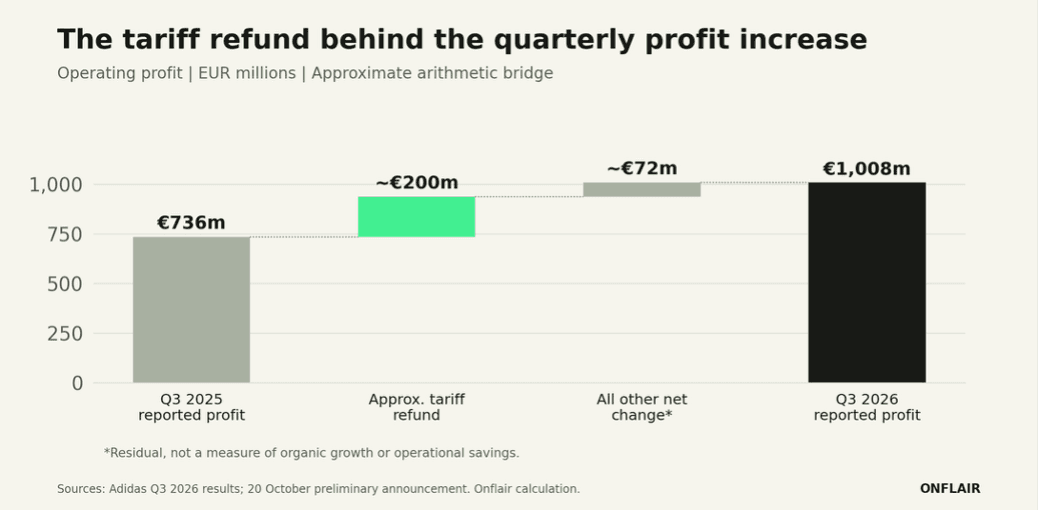
Figure 5. Illustrative arithmetic bridge using reported operating profit and the disclosed approximate refund. The €72m residual combines all other net movements; it is not an Adidas-defined measure of organic growth or operational savings.
Subtracting the disclosed refund gives approximately €808m, around 10% above the prior-year quarter. That is our calculation, not an official adjusted result. It does not remove every currency, tariff, timing or mix effect and should not be labelled underlying operating profit.
This qualification strengthens the operational analysis. It stops a financial benefit from being confused with a repeatable improvement in how the company buys, sells and delivers. Brands reviewing their own performance need the same separation between recurring changes and one-off benefits.
A practical review for a growing consumer brand
You do not need Adidas's scale to apply the discipline. Start by answering five questions with evidence rather than intuition.
1. Where is the stock really sitting? Combine owned warehouses, marketplaces and available partner data. Keep stock in transit and committed purchase orders visible. Reconcile dates and valuations before adding figures together.
2. Which sales reflect consumer demand? Separate wholesale shipments from partner sell-through. For owned channels, look at returns and discounting as well as orders. A large dispatch week can conceal weak net demand.
3. What are we about to buy again? Review upcoming commitments against current stock, forecast demand and cash. Give a named owner responsibility for excess exposure and for protecting availability on important lines.
4. Which products can we replenish reliably? Document actual lead times, minimums and supplier capacity. Design the initial buy around the replenishment option that genuinely exists, not the one hoped for in a spreadsheet.
5. How will we know the change worked? Track full-price sales, aged stock, availability, forecast bias and operating cash alongside revenue. Measure savings against a consistent baseline and keep stock reduction separate from cost savings.
These questions expose the decisions that need to change. They also help separate a temporary clearance exercise from an improvement the team can sustain.
Where the underlying causes are unclear, an operations and supply chain audit can establish the baseline and priorities. Where the challenge is coordinating delivery across teams and partners, fractional COO support provides ongoing ownership of that work.
Adidas's recovery combined products people wanted with an operation better able to support them. The part worth taking into your next buying meeting is specific: look beyond the next order and follow the stock to the customer.
You have not solved an inventory problem simply because it has left your warehouse.
Sources and further reading
1. Adidas Q3 2026 results published 29 October 2026 — quarterly results, channel growth, inventory and delivery timing.
2. Adidas preliminary Q3 announcement published 20 October 2026 — tariff refund and revised outlook.
3. Adidas 2023 income statement discussion — sales, currency, Yeezy and profit measures.
4. Adidas 2023 inventory note — inventory values and write-downs.
5. Adidas 2023 balance sheet and cash flow discussion — buying reductions and working capital.
6. Adidas 2023 CEO interview — retailer stock, product demand and relationships.
7. Adidas 2023 global operations — production volumes and distribution.
8. Adidas full-year 2024 results — profit recovery, costs, discounting and wholesale growth.
9. Adidas 2025 income statement discussion — revenue, margin and operating profit.
10. Adidas 2025 inventory note — year-end carrying values.
11. Adidas 2025 balance sheet and cash flow discussion — planned growth and World Cup stock.
12. Adidas 2025 sourcing and supply chain — replenishment and local sourcing.
13. Adidas 2025 markets and sales channels — market autonomy and channel mix.
14. Adidas 2025 roadmap — decision speed and retailer partnerships.
Financial information reviewed on 29 October 2026. Company facts are linked to public Adidas disclosures; the operational applications and worked example are Onflair's analysis. Currency amounts remain in the reporting currency, euros, except the explicitly hypothetical dollar example. This is independent commentary; Adidas is not presented as an Onflair client.