The Next Story: How the Most Boring Retailer in Britain Quietly Made £1.2bn

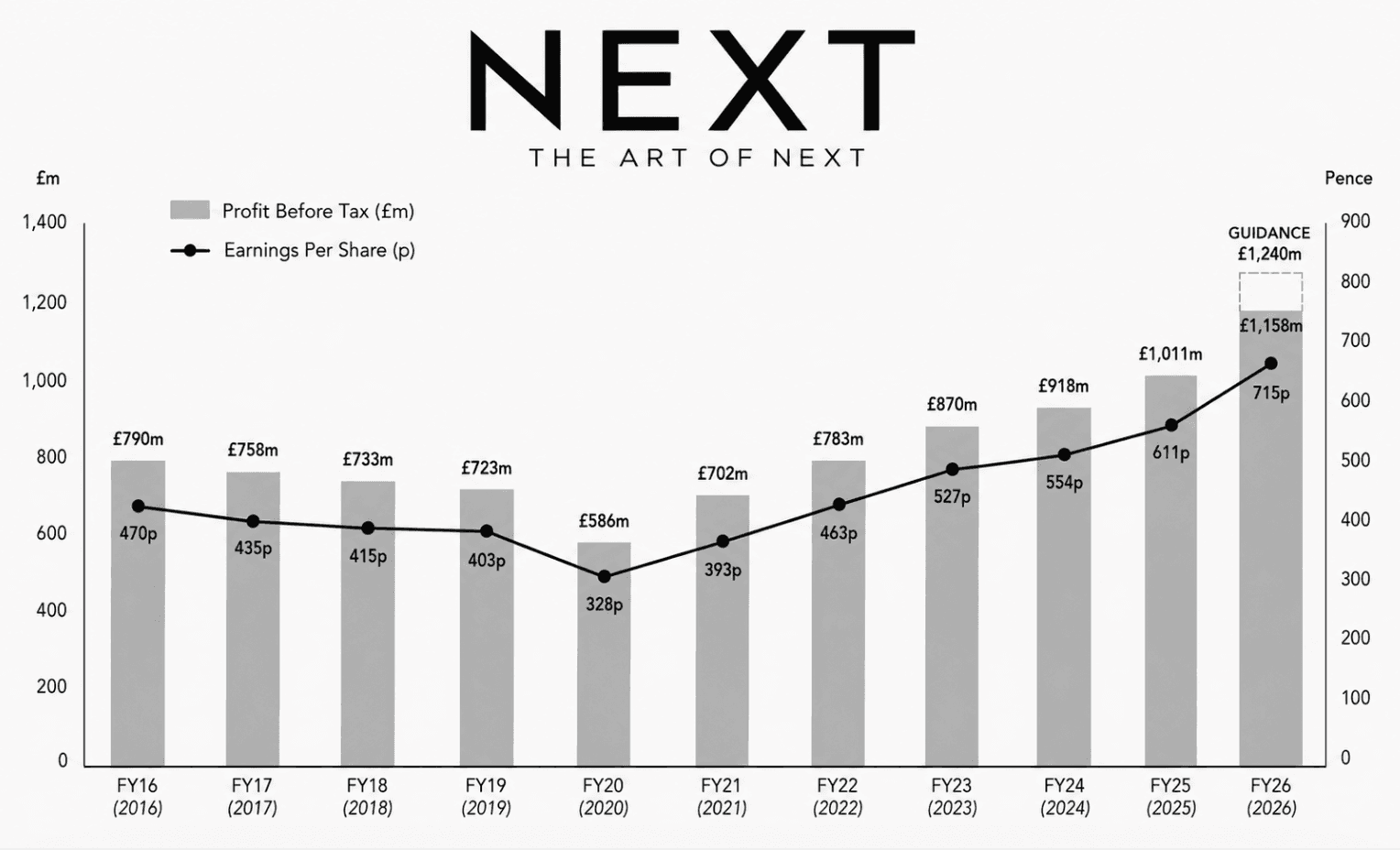
In 2018, Next described the trading environment as the toughest it had faced since its near-death experience in the early 1990s. In the year to January 2026, it reported group profit before tax of £1,158m, up 14.5%, and in August 2026 it raised guidance again, to £1.24bn.
Nothing dramatic happened in between. No rescue, no restructuring plan, no new broom chief executive. That is precisely what makes Next the most instructive company in British retail, because the story is not a turnaround. It is twenty-five years of the same three operational disciplines compounding, run by the same chief executive, through the exact conditions that killed most of its peers. Every figure here is drawn from the company's own results and statements.
The years everyone wrote the obituary
Rewind to 2016 through 2019. Next's profit slid from £790.2m to £722.9m over three years, with guidance for the year ahead lower still at £715m. There was a profit warning in January 2017. Reuters described a business that had been Britain's most successful clothing retailer this century, faltering as spending shifted from clothing to leisure.
The context made it look terminal. BHS collapsed in 2016. Toys R Us and Maplin went into administration within weeks of each other in early 2018. Debenhams, Carpetright, Mothercare and John Lewis issued warning after warning. The high street obituary was being written weekly, and Next, a business with more than 500 stores and 46% more selling space than a decade earlier, appeared in the early paragraphs of every draft.
Next's own assessment at the time was blunter and more useful than the coverage. The problem, it argued, was a structural shift from stores to online, and its response was not panic but a sentence that should be studied by every operator managing a fixed cost base. In Lord Wolfson's words, Next did not have too much space. It had too much rent, rates and service charge.
The quiet climb
What followed was not a relaunch. It was a staircase.
FY24: £918m profit, after raising guidance five times in the year. FY25: £1,011m. The first billion in the company's history. FY26: £1,158m, up 14.5%, with earnings per share up 17% and £839m returned to shareholders through dividends, buybacks and a capital distribution.
Group sales grew 10.8% in FY26 to around £6.9bn. And in its August 2026 trading statement, second quarter full price sales came in 9.2% up against a forecast of 4%, £70m ahead of the company's own expectations, with international online sales up 36.9%. Guidance rose another £25m to £1,243m.
Where did it come from? Three places, and each one has an operational name.
The leases
While rivals were locked into long leases they could not escape, Next treated its store estate as a variable cost. The mechanism was simple and relentless: negotiate hard at every renewal, and be genuinely willing to walk away when landlords would not move. In 2018 it achieved rent reductions of 25% on the leases it renewed. In 2019, 29%, with similar reductions expected the following year.
The contrast with the businesses dying around it could not be sharper. BHS and Debenhams were, in large part, killed by their leases, obligations signed in a different retail era that no amount of trading could outrun. Next's discipline meant that as footfall structurally declined, its store economics declined slower than its rent bill. Stores stayed profitable on their way down, rather than becoming anchors.
The lesson generalises far beyond retail property. Any fixed cost negotiated once and never revisited becomes a tax on the business as conditions change. Next simply refused to let any line of its cost base become permanent.
The infrastructure
Next had been delivering to homes since the late 1980s through the Directory, its catalogue business. That accident of heritage meant that when ecommerce arrived, the warehouses, logistics network, returns handling and consumer credit systems were already built, already integrated with the stores, and already profitable. Next never had to bolt an online business onto a store business at ruinous cost, which is the transition that broke so many of its peers.
Then it did something genuinely unusual: it turned the infrastructure itself into a product. Total Platform runs other brands' online operations end to end on Next's systems, and together with the equity investments that often accompany it, generated £89.7m of profit in FY26, up from £76.6m the year before. The capability that was once a cost centre is now a growth engine, and it explains the portfolio of brands Next has accumulated along the way, FatFace, Joules, Cath Kidston, Made.com, several of them bought out of administration for a fraction of their peak value, plus control of Reiss.
There is a phrase for what Next built, and it is the least glamorous phrase in business: effective infrastructure. The company's own results describe its two enduring capabilities as outstanding product and highly effective infrastructure. One of those gets magazine covers. The other one compounds.
The capital
The third discipline is the one that turns operational performance into shareholder outcomes. Next does not empire build. It guides conservatively and beats, a habit so established that its FY24 year contained five upgrades. It returns cash relentlessly, £839m in FY26 alone, split across dividends of £286.5m, buybacks of £131.4m and a £421.5m capital distribution. And the buyback programme, running for decades, steadily shrinks the share count, which is why earnings per share grew 17% on 14.5% profit growth. Every remaining share simply owns more of the business each year.
None of these three disciplines is clever in isolation. Negotiate your rent. Own your infrastructure. Return spare cash. The compounding comes from doing all three, without exception, for twenty-five years under one chief executive, Lord Wolfson, in post since 2001.
The detail almost nobody clocked
Next's statutory profit for FY26 was £1,193m. That is higher than the £1,158m headline figure the company itself leads with.
Read that again, because it is close to unique. The headline number excludes an exceptional £16m gain from a land sale, among other adjustments. In other words, Next adjusts its profit downwards to keep the underlying number honest. Almost every company in retail does the opposite, constructing an adjusted figure flattered by the exclusion of every inconvenient cost. A business that voluntarily reports a headline lower than its statutory result is telling you something about its culture that no strategy slide ever could.
The test
The billion-pound profit mark has been a curse in UK retail. M&S hit it in 1997 and 1998 and spent the better part of two decades paying for the complacency that came with it. Bloomberg framed exactly this question when Next crossed the line: whether it can be the exception.
The honest reading of the current year is that the test is live. The August upgrade was driven partly by unusually warm weather and pent-up demand, factors the company itself declines to extrapolate. International comparatives get harder from August, because last year's switch to ZEOS distribution created a one-off step change in European stock availability. And the company is carrying estimated costs from the Middle East conflict that its March guidance put at £15m for the first three months alone. Next's response to its own success is characteristically restrained: second half guidance held at 5% growth despite the 9.2% quarter. The discipline that built the compounding is, so far, surviving the success.
The lesson for operators
Strip away the FTSE 100 scale and the shape of the Next story is available to any consumer business willing to be bored by it.
Nothing that saved Next was a stroke. The leases were renegotiated one renewal at a time. The infrastructure was built and maintained over decades before it became fashionable. The capital discipline was a policy, not a reaction. Meanwhile the businesses dying around it were not killed by the internet. They were killed by rigid leases, borrowed infrastructure and undisciplined capital, three choices, made years earlier, that removed their room to adapt.
The high street did not die. Businesses that had traded away their operational flexibility died. Next spent twenty-five years being called boring for refusing to trade away its own.
Boring compounds.